Our role
A Scorpyns venture
Sector
Public accountability / governance
What we did
Product, design & engineering
Live at
When you complain to a public office, your words often vanish into a drawer. We built PublicShikayat to change that. Every complaint gets a reference number, goes to the right department on its own, and stays on record until it is truly resolved — out in the open, where anyone can see it.
People run into problems with public offices all the time. A broken road, a bill that is wrong, a service that never arrives. So they complain. They fill a form, send an email, or stand in a queue. And then, most of the time, silence. No reply, no update, no way to know if anyone even read it.
The reason is simple: there is often no real system behind the counter. A complaint lands in one person's inbox and stops there. Nobody is sure whose job it is to fix it. There is no clock ticking, no record of who did what, and no way for the public to check. When a complaint is finally lost, no one can even prove it existed.
That gap is not just annoying. It quietly kills trust. When people believe their voice disappears, they stop speaking up — and offices lose the very feedback they need to do better. We wanted to close that gap with a system that treats every complaint as a promise on the record.
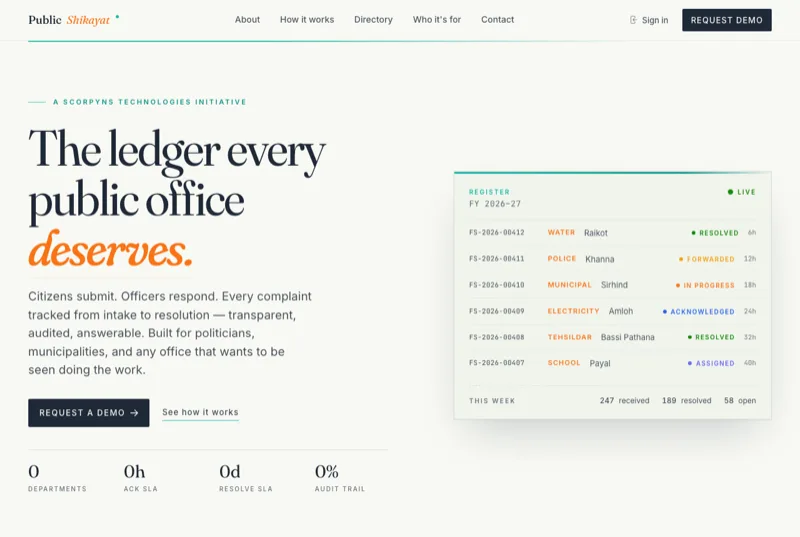
Every complaint gets its own number the moment it is filed. That number is proof it exists — and a simple way to look it up anytime.
Each complaint goes straight to the right department on its own. No guessing, no forwarding chains, no waiting for someone to pass it along.
Complaints and their progress sit in an open record. Anyone can see what was raised, where it stands, and whether it was resolved.
Every case has a clock. If a complaint sits too long, the system flags it — so delays are seen, not hidden.
The hard part of a grievance system is not the form. It is what happens after. So we started from the end: what does it take for a person to trust that their complaint is safe on the record and will get a fair look? That question shaped every screen.
We kept the citizen side dead simple. File a complaint, get a number, check its status anytime — no login maze, no jargon. On the office side, we built the plumbing that makes the promise real: routing rules that send each case to the right desk, timers that keep things moving, and a log that records every step so nothing can be quietly undone.
Because PublicShikayat is our own venture, we did not build it, hand it over, and walk away. We run it. That means we keep tuning the routing, watching where cases get stuck, and improving the flow based on how it actually behaves in the real world.
The biggest change is one of kind, not degree. A complaint is no longer a message that might be read and might be lost. It is a tracked case with a number, an owner, and a clock — something a person can point to and follow.
For the public, that means proof instead of hope. You can see where your complaint sits and whether it moved. For an office, it means the same view that citizens have: a clear list of what is open, what is overdue, and where attention is needed. Delays that used to hide in an inbox now sit in plain sight.
It is a real, working platform — not a demo — built and run by our team. That shift, from private silence to a public record, is the whole point. And it is the kind of software we build for our own ventures, and the kind we build for clients.

If you need real software that stands up under pressure, let's talk. One free call, one honest plan.
Start a conversation →