Our role
Built & run by Scorpyns
Sector
Political campaigns
What we did
Product, design & engineering
Live at
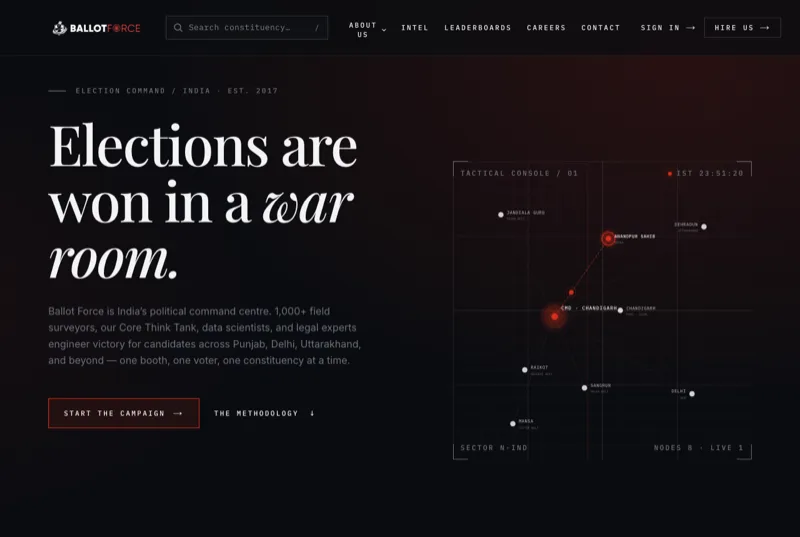
A campaign runs on decisions made under pressure with patchy information. We built Ballot Force to fix that — one command centre where a candidate's team can see the ground as it really is: who the voters are, where the mood is shifting, and what the field team is doing right now.
Election campaigns move fast and cost a lot. Yet many of the biggest choices — where to hold a rally, which issues to raise, which booths need attention — are still made on gut feeling and stale paper lists. By the time useful information reaches the candidate, it is often days old and second-hand.
The team behind the campaign came to us with a simple frustration: they had people and energy on the ground, but no single place to see what all of it added up to. Data lived in spreadsheets, WhatsApp groups, and people's heads. Nothing talked to anything else.
They needed one system that could pull the ground together into a clear picture — fast enough to act on the same day, and simple enough that a busy field worker could use it from a phone.
Every area mapped and colour-coded, so the team can see support, swing and weak spots at a glance — not buried in a spreadsheet.
A read on how the mood is moving across issues and areas, so the campaign can respond to what people actually care about.
Updates flow in from the ground and show up on one screen in near real time — no waiting days for a report.
Tasks, teams and areas in one place, so everyone knows who is doing what and where the gaps are.
A campaign has a hard deadline that never moves — election day. So we did not spend months building in secret and hoping. We got a working version into the team's hands early, watched how they really used it, and improved it in tight loops.
That mattered because the way a war room works is not the way it looks on paper. Real field workers taught us what was clumsy and what was missing. We kept the screens simple, the maps fast, and the whole thing steady even when everyone piled in at once.
Because Scorpyns both built and runs Ballot Force, we were not a vendor who hands over a file and disappears. We stayed on the tools through the pressure — fixing, tuning and adding as the campaign moved.
Ballot Force replaced a pile of guesswork with one clear picture. Instead of arguing over whose spreadsheet was right, the team could look at the same live map and decide together — where to focus, what to say, and which areas needed a push.
The biggest change was speed. Information that used to take days to travel from the field to the top now showed up on a dashboard the same day. That let the campaign act while it still mattered, not after the moment had passed.
It is a real, working platform — not a demo — built and run by our team. That is the kind of software we build for our own ventures, and the kind we build for clients.

If you need real software that stands up under pressure, let's talk. One free call, one honest plan.
Start a conversation →